
Laser light reveals unexpected twist in non-repeating tile pattern
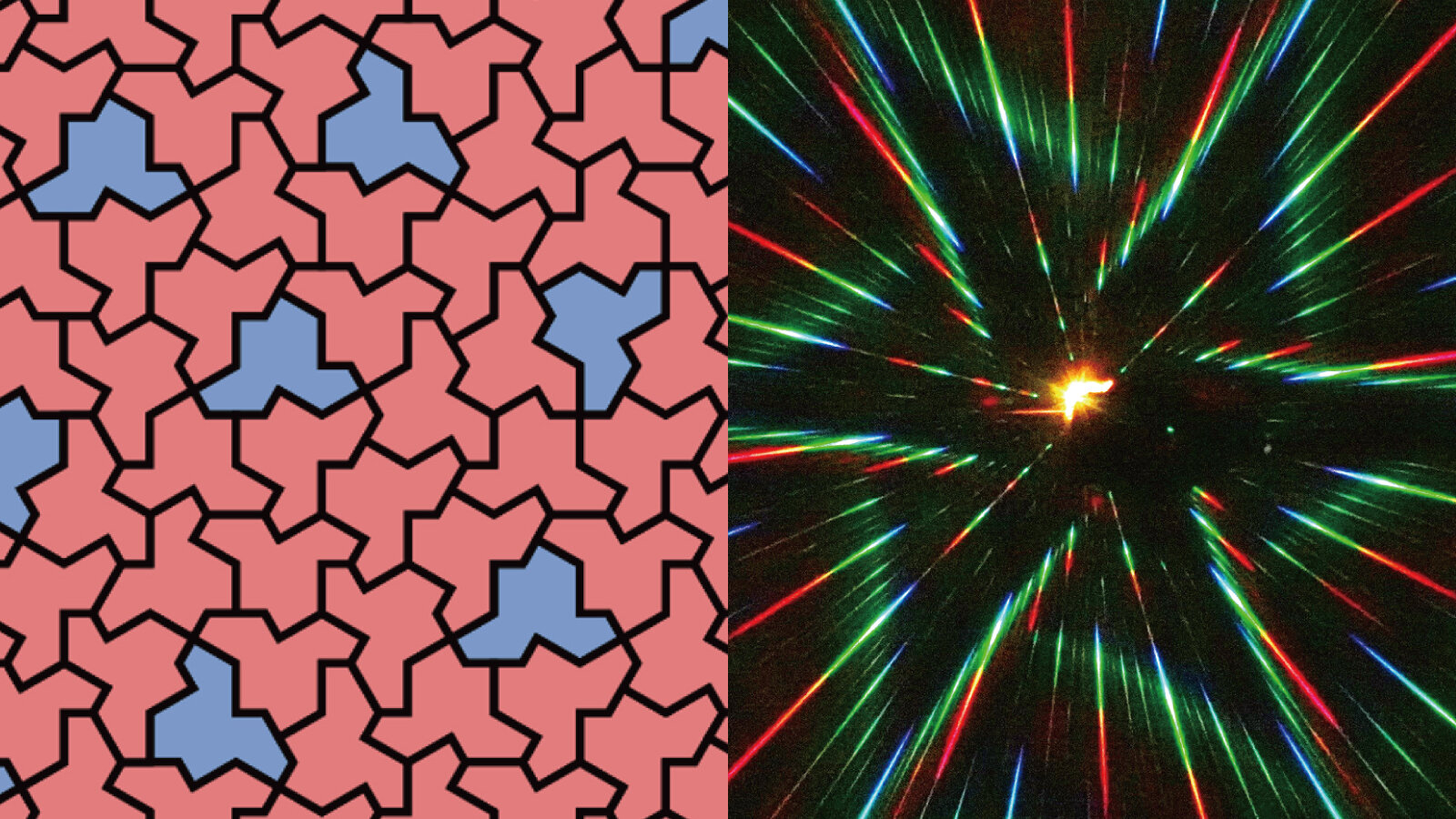
Researchers from the Institute of Industrial Science at The University of Tokyo shone laser light onto nanoscale structures built from the "Smith hat" tile and found diffraction behavior never seen before in conventional quasicrystals. The Smith hat tile, or monotile, answered the so-called Einstein problem: whether a single tile shape can cover a surface without the pattern ever repeating. The result was pinwheel-like diffraction patterns that revealed the structure's chiral nature. Senior author Masaya Notomi said the diffraction patterns themselves become chiral because the structure lacks mirror symmetry, a response he called fundamentally different from what shows up in conventional quasicrystalline materials. The findings appear in Nature Communications.
The aperiodic structure gives physicists and optical engineers a new way to bend and twist light into chiral patterns, something conventional quasicrystals do not do.
Source: A new twist on the Einstein problem reveals unexpected physics (iis.u-tokyo.ac.jp).
Written by the HappyGood desk from the primary source linked above and checked against it. Every story links its source. Corrections: [email protected].
More from the archive
- Chinook salmon return to the Klamath River after record dam removal September 16, 2026
- Boston invests $500,000 to study heating buildings with water September 16, 2026
- NASA asks skywatchers to observe the Moon on September 19 September 16, 2026
- Christian Bale's Palmdale village will keep foster siblings under one roof September 16, 2026
- Healesville Sanctuary turns to thermal cameras to check on hibernating pygmy-possums September 16, 2026