
Ancient Martian meteorite preserves evidence of liquid water
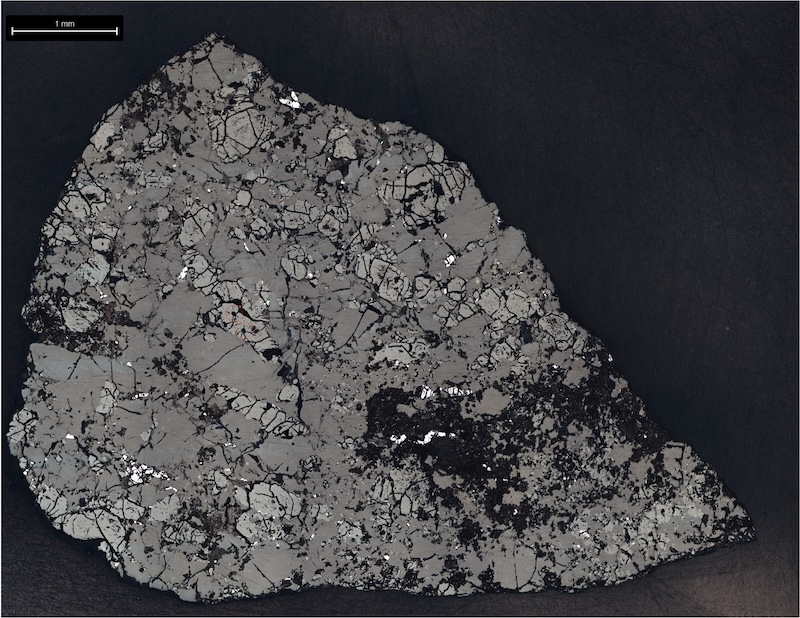
A 4.1-billion-year-old Martian meteorite contains altered minerals and large amounts of manganese oxide, evidence that it once lay in a wetter environment. Called Teghaza 001, the rock was found in the Sahara Desert in Mali in 2022. Researchers published their findings in Science on October 29, 2026. On Earth, manganese oxide is a common byproduct of microbial life, but its presence does not prove ancient life existed on Mars.
Carl Agee and Karen Ziegler at the University of New Mexico examined the meteorite. Under a microscope, Agee found areas rich in manganese oxide, a compound Mars rovers seek as an indicator of environments that could support life. Altered minerals and unusual oxygen isotopes, forms of oxygen atoms, also pointed to past contact with liquid water.
The team dated tiny zircon crystals by measuring uranium and lead within them. These crystals allow scientists to date igneous rocks, which form as molten material cools. Agee described Teghaza 001 as the oldest Martian igneous rock ever found. It consists of a single rock type, unlike Black Beauty, a Martian meteorite containing a mixture of rock types, some of similar age.
Teghaza 001 samples the Pre-Noachian period, Mars’ earliest geological epoch, approximately 4.5 to 4.1 billion years ago. Agee said its altered composition reflected an environment with surface waters and volcanic systems where heat interacted with water. Lead author Yang Liu, at NASA’s Jet Propulsion Laboratory in Southern California, said: "One of the paper’s reviewers called it a Rosetta Stone for Mars."
Its precise birthplace remains unknown. The researchers narrowed the possibilities to 13 primary locations, several in the Southern Highlands.
Identifying where Teghaza 001 came from could help scientists plan future rover missions and choose where to send them.
Source: ‘Rosetta Stone for Mars:’ Martian meteorite hints at ancient life (earthsky.org).
Written by the HappyGood desk from the primary source linked above and checked against it. Every story links its source. Corrections: [email protected].
More from the archive
- Glass salp is first salp species known to live only in deep sea November 25, 2026
- Oyster-farming family honoured for rescuing more than 100 neighbours November 24, 2026
- Steve Guest walks again after back operation and celebrates 79th birthday November 24, 2026
- Seven families adopt 10 children at Long Island Aquarium November 24, 2026
- Dark Energy Camera captures most detailed view of Betta Fish Nebula November 24, 2026