
Venus Express launched to study the planet’s atmosphere
The European Space Agency launched Venus Express from the Baikonur Cosmodrome in Kazakhstan on 9 November 2005, beginning its first mission to Venus. The spacecraft arrived in April 2006 and began sending back scientific data from an orbit passing over the planet’s poles. Its main task was to observe the atmosphere over long periods, something previous Venus missions had not done, to help scientists understand how it behaved.
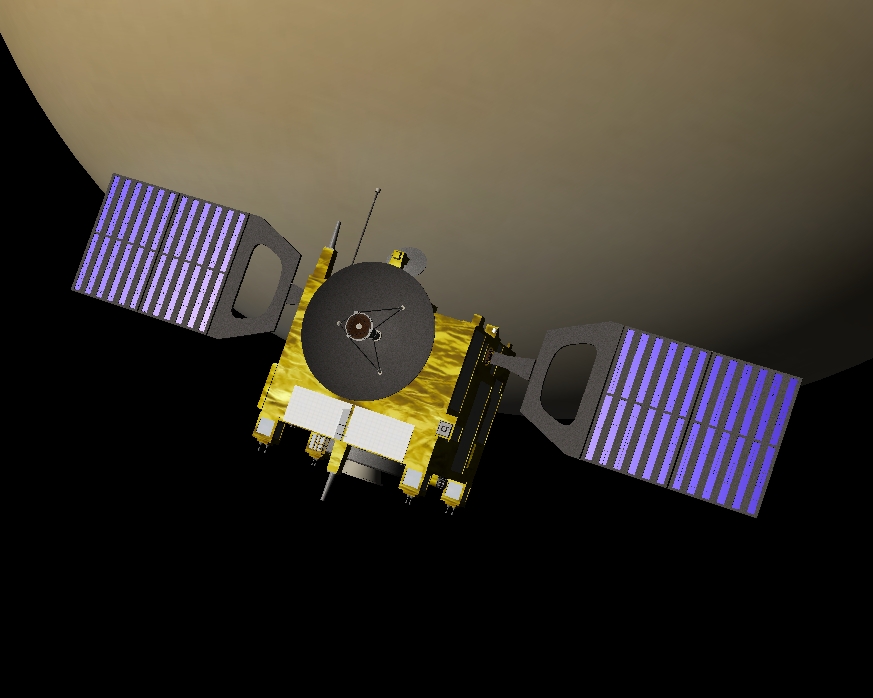
Venus and Earth began with similar sizes and chemical compositions, but developed very differently. Venus Express data were intended to help explain the structure of Venus’s atmosphere and the changes that led to its present greenhouse conditions.
The spacecraft carried seven scientific instruments. Its Venus Monitoring Camera took images in visible light, ultraviolet and near infrared to study cloud tops and search for volcanic activity. Venus Radio Science sent radio waves through the atmosphere or reflected them from the surface. A station on Earth received the signals for analysis.
Proposed in 2001, the mission reused the Mars Express design, with changes to temperature control, communications and electrical power systems. Closer to the Sun, Venus Express faced four times the radiant heating experienced by Mars Express. Several instruments drew on designs used for Mars Express or Rosetta.
The Planetary Fourier Spectrometer, designed to monitor atmospheric temperatures and investigate gases, failed during deployment and returned no useful data. The spacecraft also produced magnetic interference that complicated measurements of Venus’s magnetic field. Scientists combined readings from paired sensors and used software to remove that interference, obtaining results comparable in quality to those from a spacecraft without such interference. ESA concluded the mission in December 2014.