
Pilâtre de Rozier and d'Arlandes make first crewed free balloon flight
Jean-François Pilâtre de Rozier and François Laurent d'Arlandes made the first crewed free balloon flight over Paris on 21 November 1783. It was the first confirmed human flight of any kind. Their Montgolfier hot air balloon flew without ropes attaching it to the ground, from the garden of the Château de la Muette in the Bois de Boulogne to the Butte-aux-Cailles, then on the city's outskirts.
They took off at around 2 pm in the presence of the king. Over 25 minutes, they travelled about 5½ miles (some 9 km) to the southeast, reaching an altitude of 3,000 feet. They had practised controlling the balloon in several tests with ropes keeping it attached to the ground.
Pilâtre de Rozier had watched the Montgolfier brothers give their first public balloon demonstration in June 1783. On 19 September, he helped with an untethered flight carrying a sheep, a cockerel, and a duck from the front courtyard of the Palace of Versailles.
French King Louis XVI initially decided that two condemned criminals would make the first manned flight. Pilâtre de Rozier sought support from the Duchess de Polignac, arguing that the honour should go to someone of higher status. The Marquis d'Arlandes agreed to accompany him, and the king permitted them to become the first pilots.
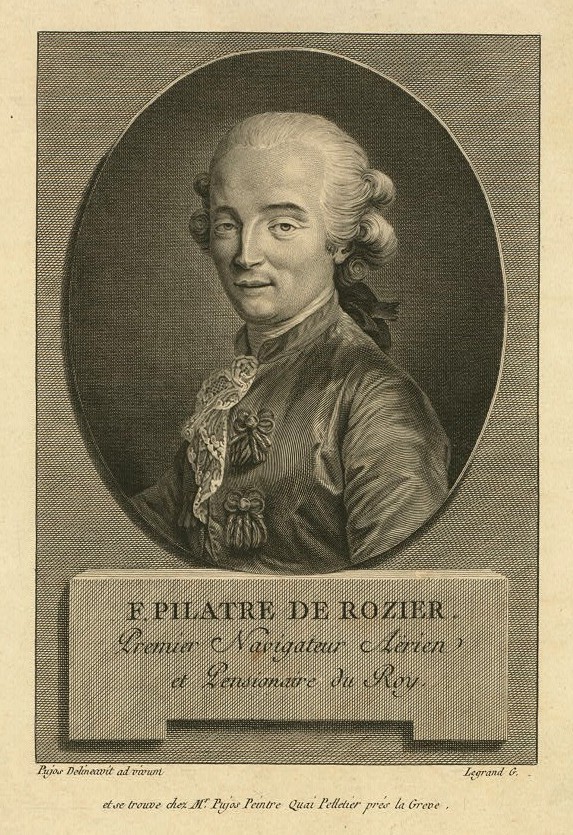
Born in Metz, Pilâtre de Rozier moved to Paris at 18 and later taught physics and chemistry at the Academy in Reims. He opened his own museum in the Marais quarter of Paris on 11 December 1781, conducting physics experiments and giving demonstrations to nobles. He also researched gases and invented a respirator.
On 19 January 1784, he and Joseph Montgolfier were among six passengers aboard Le Flesselles, a huge balloon launched from Lyon. It flew only a short distance. On 23 June 1784, he flew with Joseph Proust above the clouds at about 3,000 metres. They travelled 52 km in 45 minutes before cold and turbulence forced them to descend, setting records for speed, altitude, and distance travelled.