
Pauli Murray's legal work shaped protections against gender discrimination
Pauli Murray, whose work influenced the civil rights movement and expanded legal protection for gender equality, was born on 20 November 1910 in Baltimore, Maryland. A lawyer and author who later became an Episcopal priest, Murray faced discrimination in her own education. In 1971, Ruth Bader Ginsburg named her as a coauthor of the ACLU brief in the Supreme Court case Reed v. Reed, recognising her work on gender discrimination.
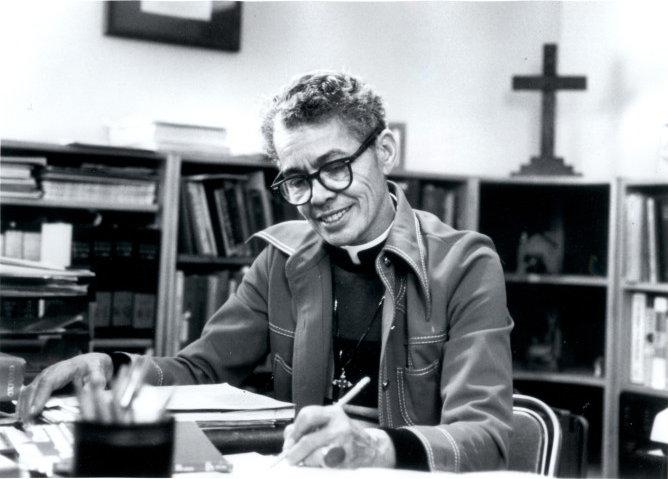
Raised mostly by her maternal aunt in Durham, North Carolina, Murray moved to New York City at 16. She attended Hunter College, a free women's college where she was among the few students of color, and graduated with an English degree in 1933. An essay about her maternal grandfather became the basis of her memoir Proud Shoes, published in 1956.
In 1940, Murray and a friend were arrested after sitting in the whites-only section of a Virginia bus. The incident and her work with the Workers' Defense League led her towards a career in civil rights law. At Howard University, she was the only woman in her law school class and graduated first in 1944. Harvard University denied her postgraduate study because of her gender. She called prejudice against women "Jane Crow", a reference to the Jim Crow laws that enforced racial segregation.
A Rosenwald Fund fellowship enabled Murray to earn a master's degree in law at University of California, Berkeley. Thurgood Marshall, chief counsel of the National Association for the Advancement of Colored People, called her 1950 book States' Laws on Race and Color the "bible" of the civil rights movement. In 1965, she became the first African American to receive a Doctor of Juridical Science degree, an advanced research degree in law, from Yale Law School.
Murray helped found the National Organization for Women in 1966. She left academia in 1973 for activities associated with the Episcopal Church. In 1977, she became the first African-American woman ordained as an Episcopal priest.