
Louis Daguerre, the man who "seized the light", was born on 18 November 1787
Louis-Jacques-Mandé Daguerre was born on 18 November 1787 in Cormeilles-en-Parisis, Val-d'Oise, France. Before photography made him famous he was a celebrated theatre designer, and the diorama he invented opened in Paris in July 1822. The photographic process named after him, the daguerreotype, was made public in 1839. On 19 August that year the French Government presented it as a gift "free to the world", and complete working instructions were published. He became known as one of the fathers of photography.
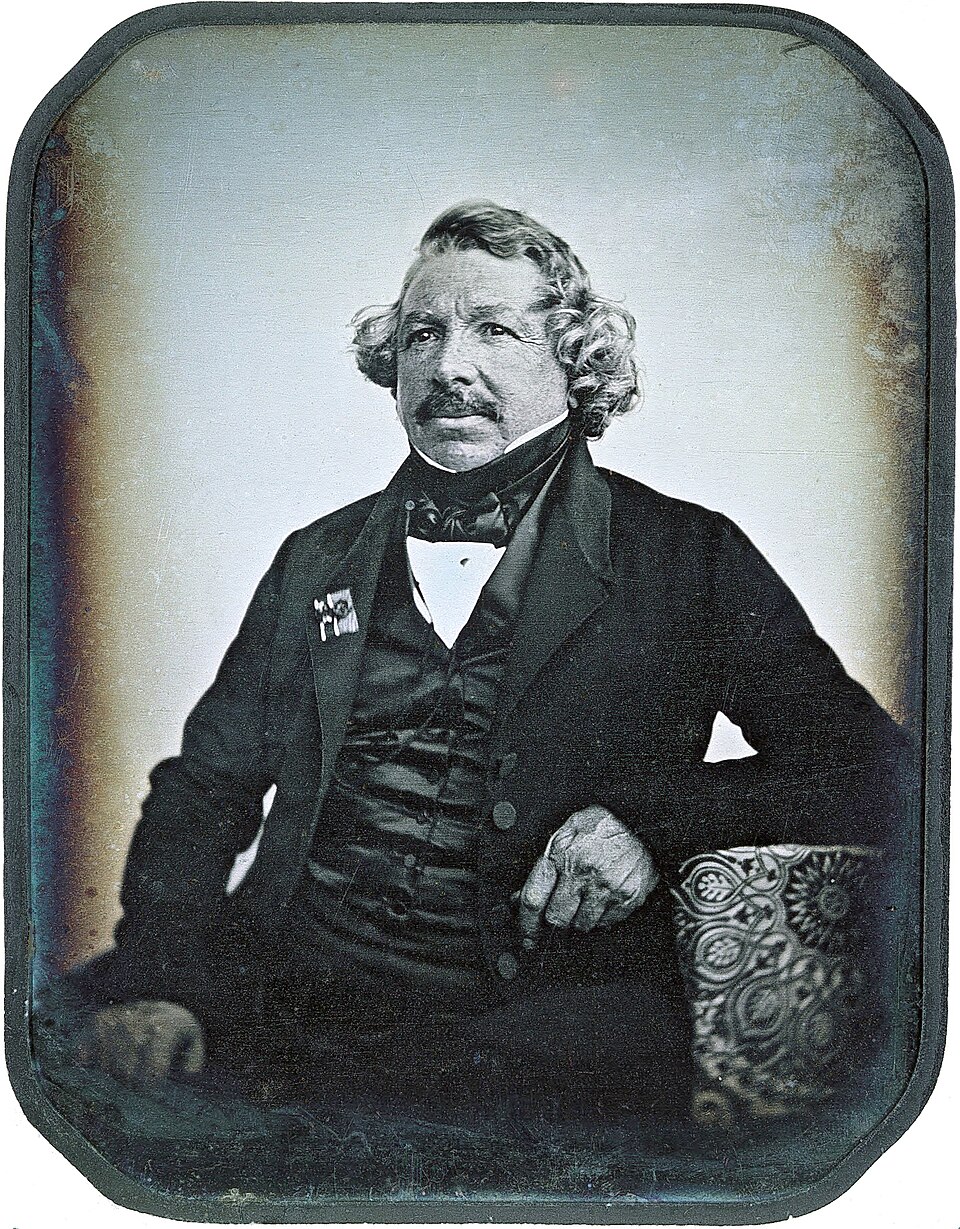
He was apprenticed in architecture, theatre design and panoramic painting to Pierre Prévost, the first French panorama painter. In 1829 he partnered with the inventor Nicéphore Niépce, who had made the oldest surviving camera photograph in 1826 or 1827. Niépce's method needed a camera exposure of hours or days. Niépce died suddenly in 1833, but Daguerre continued experimenting.
He exposed a thin silver-plated copper sheet to vapour from iodine crystals. This left a light-sensitive coating of silver iodide on the surface. His crucial discovery was that a much shorter exposure produced a faint, invisible "latent" image, which chemistry could then bring out. Vapour from mercury heated to 75 °C made it visible. Heated salt water then "fixed" it, so further light could no longer affect it. On seeing an image whose contents are unknown, Daguerre said, "I have seized the light," adding, "I have arrested its flight!"
On 7 January 1839 the invention was described in general terms to a joint meeting of the French Academy of Sciences and the Académie des Beaux Arts. All specific details were withheld. Daguerre explained and demonstrated the process only to François Arago, the Academy's perpetual secretary, who proved to be an invaluable advocate. The French Government acquired his rights in exchange for lifetime pensions for Daguerre and for Niépce's son Isidore. Britain was left out of the free gift. Days before France declared the invention "free to the world", Daguerre's agent Miles Berry had applied for a British patent, which made it the only country where licence fees had to be paid.
At first, brightly sunlit subjects needed exposures of ten minutes or more, so sitting for a portrait was an ordeal. Samuel Morse was astonished that daguerreotypes of Paris streets showed no people, and no horses or vehicles either. Then he realised that anything moving had vanished during the long exposure. Within a few years, extra sensitising chemicals and faster lenses had cut exposures to as little as a few seconds. Each plate was a unique image that could only be copied by photographing it. Even so, millions were produced.
Daguerre died of a heart attack on 10 July 1851 in Bry-sur-Marne. His name is one of the 72 inscribed on the Eiffel Tower.