
Sor Juana, Mexico's 'Tenth Muse', could read and write Latin by age three
Wikipedia's On This Day entry for 12 November gives 1651 as the birth year of Sor Juana Inés de la Cruz, the nun and poet her contemporary critics called "The Tenth Muse". That year is not settled. Two baptism records have been attributed to her, one under the name "Juana" in 1648 and another under "Inés" in 1651, and the question is still a matter of academic research and debate. She was born in San Miguel Nepantla, near Mexico City. She became a Hieronymite nun, a writer, philosopher, composer and poet who also studied science, and she is considered one of the most important female writers in Spanish language literature.
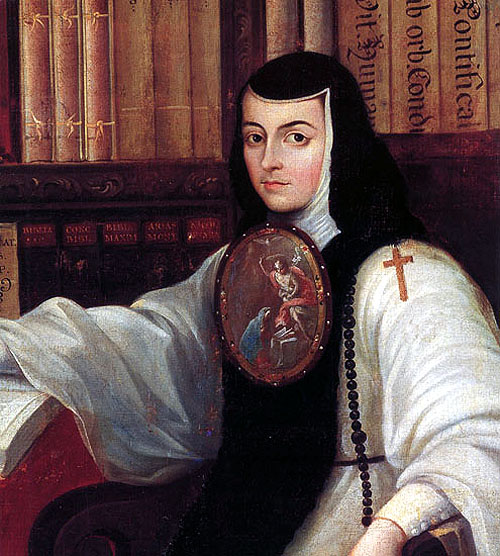
Her father was a Spanish navy captain from the Canary Islands who left her life when she was young. She was raised by her mother's family at the Hacienda de Panoayan, which her maternal grandfather leased. As a girl she hid in the hacienda chapel to read his books, something forbidden to girls. By three she could read and write Latin. She composed a poem on the Eucharist at eight and was teaching Latin to young children at thirteen.
In 1664 she was sent to live in Mexico City. She asked her mother for permission to disguise herself as a male student so she could enter the university there, without success. Her family's influence got her a place as lady-in-waiting at the viceroy's court. The viceroy, the Marquis de Mancera, wanted to test her learning and invited theologians, jurists, philosophers and poets to question her. She had to answer unprepared, and the way she handled it astonished everyone present. She turned down several marriage proposals.
In 1669 she entered the monastery of the Hieronymite nuns and took the name Sor Juana Inés de la Cruz. She became a nun because she wanted "to have no fixed occupation which might curtail my freedom to study." At the Convent of Santa Paula in Mexico City she wrote, studied and collected a large library. The viceroy and vicereine had her writings published in Spain, and her quarters became a salon for New Spain's female intellectual elite.
Her criticism of misogyny and the hypocrisy of men led to her condemnation by the Bishop of Puebla. In 1694, by one account, she was forced to sell her books. Other sources report that her books and instruments were confiscated. She died the following year, having caught the plague while treating her fellow nuns.