
Elizabeth Cady Stanton, born in 1815, was the main force behind Seneca Falls
Elizabeth Cady was born on November 12, 1815, into the leading family of Johnstown, New York. As Elizabeth Cady Stanton, a writer and activist, she became a leader of the women's rights movement in the U.S. during the mid- to late-19th century. She was the main force behind the 1848 Seneca Falls Convention, the first convention called for the sole purpose of discussing women's rights, and the primary author of its Declaration of Sentiments. Her demand there for women's right to vote caused controversy at the convention. Soon afterward it became a central tenet of the women's movement.
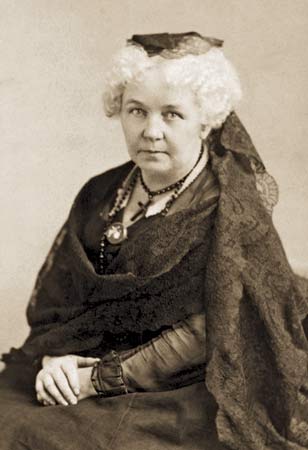
Her father, Daniel Cady, was a conservative attorney and one of the richest landowners in the state. Of the eleven Cady children, six died before reaching full adulthood, all of the boys among them. When Eleazar, her last surviving brother, died at 20, ten-year-old Elizabeth told her grieving father she would try to be all her brother had been. He replied, "Oh my daughter, I wish you were a boy!"
She got a better education than most women of her era. At Johnstown Academy she was the only girl in the advanced classes in mathematics and languages, and she won second prize in the school's Greek competition. Her father brought her law books so she could debate his law clerks at the dinner table. She wanted to go to college, but no college then accepted women. Her father at first decided she needed no further schooling, then agreed to enroll her in the Troy Female Seminary, which Emma Willard founded and ran.
In 1851 she met Susan B. Anthony, and the two began a partnership that lasted decades. During the Civil War they set up the Women's Loyal National League to campaign for the abolition of slavery and led it in the largest petition drive in U.S. history up to that time. In 1868 they started a newspaper, The Revolution.
After the war they opposed the Fifteenth Amendment, which would give the vote to black men only. They insisted that all African Americans and all women be included at the same time. Others in the movement backed the amendment, and the movement split. In the bitter arguments before the split, Stanton sometimes used elitist and racially condescending language. Frederick Douglass, an abolitionist friend who had escaped from slavery, reproached her for such remarks. She became the first president of the National Woman Suffrage Association. When the split healed more than twenty years later, she was the first president of the united National American Woman Suffrage Association, a largely honorary post. She died on October 26, 1902.